


Offline Yoga Teacher Training Course
Online Yoga Teacher Training Course
Contact us
Address:
#195 3rd Main, 9th Cross, CBI Road, Ganganagar, RT Nagar, Bangalore 560032
Email: contact.yogakulam@gmail.com
Call: +91 7829210166
A yoga class can contain all the "right" poses and still feel completely wrong.
The transitions may feel rushed. Students may become tired before the most important part of the practice. A beginner may feel lost, while an experienced student may not understand the purpose of the sequence.
Learning how to sequence a yoga class is therefore not simply about deciding which asana comes next. Effective yoga class sequencing requires a teacher to understand the students, define a clear purpose, prepare the body gradually, manage effort and rest, offer suitable modifications and bring the practice to a meaningful conclusion.
A sequence is not merely a list of postures.
It is the journey you create for your students.
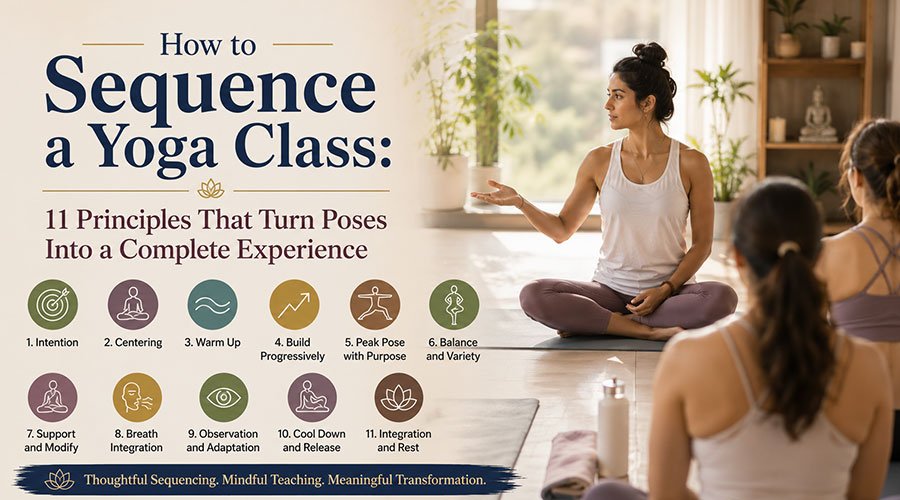
Yoga class sequencing is the process of arranging breathwork, movements, asanas, transitions, relaxation, and meditation into a well-structured practice. A thoughtfully designed sequence helps students move smoothly from one stage of the class to the next without feeling confused, rushed, or physically unprepared.
Although the exact structure varies depending on the yoga style, class duration, and the experience level of the students, a complete yoga class generally follows a natural progression:
The goal is not to make every class follow the same formula, but to ensure that each stage naturally prepares students for the next, creating a safe, enjoyable, and meaningful yoga experience.
Imagine asking students to perform a deep backbend before properly preparing their shoulders, spine, hips, and breath. Even if a few students are physically capable of performing the posture, the sequence has not adequately prepared the entire class.
A well-planned yoga sequence helps teachers:
Effective sequencing also gives the class a clear sense of direction. Students may not consciously analyse every transition, but they can usually feel the difference between a thoughtfully designed practice and one that is simply a random collection of poses.
One of the most common mistakes in yoga sequencing is choosing impressive postures before considering who will actually attend the class.
Before creating your sequence, ask yourself:
A sequence that works well for experienced Ashtanga practitioners may not be suitable for beginners, older adults, prenatal students, or individuals returning after an injury.
Your class should always be designed for the students in front of you-not for the teacher you want to impress.
Teaching Principle: Know your students before designing your sequence.
Every yoga class should begin with a clear intention or purpose. This intention may be physical, educational, energetic, or philosophical.
For example, your class may focus on:
Your chosen intention should influence every aspect of the class, including the postures, breathing techniques, transitions, teaching cues, pace, and closing meditation.
For example, if your intention is to cultivate grounding and relaxation, constantly moving students through fast, complicated transitions may contradict that goal.
Ask yourself: What should students understand, experience, or feel by the end of this class?
If you cannot answer this question clearly, your sequence may need greater focus.
A yoga class should feel like one complete journey rather than a collection of unrelated movements.
A practical class structure may include:
The amount of time spent in each stage depends on the style and purpose of the class. A restorative class naturally includes more relaxation, while a Vinyasa class may spend more time in progressive movement. Beginner classes often require additional explanation and demonstration.
The structure should always serve the students-not force every class into the same template.
Students often arrive carrying stress from work, travel, family responsibilities, or other daily challenges. Beginning immediately with complex movements or instructions may make it harder for them to settle into the practice.
The opening few minutes may include:
Whatever you include at the beginning should connect naturally with the rest of the class.
A long philosophical discussion can feel disconnected if it is never referenced again, just as an advanced pranayama technique should not be included simply because every class is expected to have breathing exercises.
Every element of your sequence should have a clear purpose and support the overall intention of the practice.
A warm-up should never become a routine that is repeated before every yoga class. Instead, it should prepare students specifically for the movements and physical demands that follow.
For example, a backbending-focused class may include preparation for:
A balance-focused class may prepare students through:
For a twisting-focused practice, the warm-up may gradually introduce:
Avoid warming up the body randomly. Instead, identify the mobility, strength, stability, coordination, and confidence your students will need later in the class and prepare those qualities progressively.
Important: Feeling warm is not the same as being prepared. Students may feel physically warm after several rounds of Surya Namaskar, but that does not necessarily mean they are ready for every posture.
Many yoga teachers design their classes around a peak pose, which represents the most physically or mentally demanding point of the practice.
A well-planned sequence gradually introduces the actions and movements required for that posture.
For example, a class preparing students for Ustrasana (Camel Pose) may progressively develop:
However, the peak experience does not always need to be an advanced yoga posture. It may also be:
Students should never feel that the class has failed simply because they could not perform one final posture. The purpose of a peak sequence is to encourage preparation, exploration, and learning-not pressure or perfection.
A well-designed yoga class may include several categories of movement, including:
However, balance does not mean including one posture from every category. It means understanding how different movements affect the body and how much demand they place on specific joints and muscles.
For example:
Rather than counting poses, consider the overall movement experience.
Ask yourself:
The objective is not perfect symmetry-it is the thoughtful distribution of physical effort throughout the class.
A yoga sequence may look excellent on paper but still feel awkward if the teacher has not planned how students will move between postures.
Transitions influence:
Before teaching, consider every major transition carefully.
Ask yourself:
Transitions do not always need to be creative. A simple, smooth, and clearly explained transition is usually more effective than a complicated one that leaves students confused.
Practical Tip: Practise your entire sequence-including every transition-before teaching. Notice where you lose balance, hold your breath, change direction awkwardly, or need more time than expected.
Yoga modifications should never be treated as last-minute solutions when a student struggles. They should be built into the original lesson plan from the beginning.
For every challenging posture, consider including:
Offer every variation with equal respect. Avoid presenting one version as the "real" pose and every other option as a lesser achievement.
Every student brings different body proportions, mobility, strength, experience, health history, and energy levels into the classroom. An effective teacher creates an inclusive experience while respecting those individual differences.
Modifications are not evidence that a sequence has failed-they are evidence of thoughtful, responsible teaching.
Understanding yoga sequencing in theory is valuable, but confidently teaching a live class requires much more than simply knowing the order of postures.
A skilled yoga teacher learns how to:
These essential teaching skills are developed through the Teaching Methodology component of Yogakulam Academy's 200-Hour Yoga Teacher Training Course in Kerala.
The comprehensive 24-day residential program combines traditional yoga practices with anatomy, alignment, pranayama, meditation, yoga philosophy, class sequencing, teaching methodology, and supervised teaching practicum.
Whether you are an aspiring yoga teacher or a dedicated practitioner seeking a deeper understanding of yoga, the program provides a structured pathway to becoming a confident and knowledgeable instructor.
Effective sequencing is about far more than arranging physical postures. The teacher's voice, breathing cues, and pacing strongly influence how students experience the entire practice.
Even a carefully planned sequence can become difficult to follow if the instructions are:
Whenever possible, offer the most important instruction first. Rather than explaining every detail before students enter a posture, guide them through the movement step by step.
A simple teaching progression may include:
Silence is also an important teaching tool. Students need occasional moments to observe their breath, body, and sensations without receiving continuous instructions.
The pace of your voice should always support the intention of the class. A restorative or calming practice benefits from slower language and longer pauses, while an energetic Vinyasa class may use a more dynamic rhythm without compromising breath awareness.
One of the most common sequencing mistakes is spending too much time on the active portion of the class and rushing through the ending.
Savasana should never become the final two minutes left after teaching everything else.
A thoughtful closing sequence may include:
The purpose of the closing sequence is not simply to "undo" previous postures. Instead, it helps the body and mind transition gradually from physical effort into relaxation, integration, and stillness.
Plan your ending before teaching the class. Work backwards from the scheduled finishing time and protect the time reserved for rest.
A complete yoga class does not end when the most challenging posture is finished-it ends when students have been given enough time to fully absorb the experience.
The following framework provides a practical guide for planning a balanced 60-minute yoga class. It is designed as a flexible template that can be adapted according to your students, teaching style, and the overall intention of the class.
Rather than following a rigid formula, use this framework as a starting point to create safe, engaging, and purposeful yoga sessions.
Help students transition from the outside world into their yoga practice by encouraging calmness, awareness, and presence.
This stage may include:
Prepare the body gradually through gentle movements that awaken the joints, spine, muscles, and nervous system.
This stage may include:
Gradually increase body temperature while preparing students for more challenging movements later in the class.
This phase may include:
This section forms the core of the active practice and develops strength, stability, balance, and confidence.
It may include:
This stage represents the primary focus of the class. The peak experience may be a challenging posture, a breathing practice, a movement sequence, or a meditative experience.
This section should include:
Gradually reduce the physical intensity and help students absorb the effects of the main practice.
This stage may include:
Finish the practice by allowing students to fully integrate the physical, mental, and emotional benefits of the class.
The closing sequence may include:
This sequence is intended as a planning guide rather than a fixed formula.
Every yoga class should be adapted to the students, teaching style, and desired outcome. For example:
The most effective yoga sequences are those that meet students where they are, guide them safely through the practice, and leave them feeling balanced, supported, and inspired.
The following example demonstrates how a beginner-friendly yoga sequence can be organised around a clear intention. Every stage of the class supports the overall theme of grounding, helping students develop stability, body awareness, and a calm connection with their breath.
Develop stability, body awareness, and a calm connection with the breath.
Begin by helping students settle into the present moment.
Gradually prepare the spine, joints, and nervous system for movement.
Increase warmth and confidence while introducing foundational standing postures.
Explore the central theme of stability and balance through accessible standing postures.
Gradually reduce intensity and allow students to absorb the benefits of the practice.
This sequence remains intentionally simple, with every stage reinforcing the central theme of grounding and mindful awareness.
Adding more postures does not automatically create a better yoga class. Most students benefit far more from a clear, well-paced, and purposeful sequence than from trying to complete as many poses as possible.
A sequence found online may have been designed for a completely different student group, class duration, yoga style, or teaching objective.
Before using any sequence, understand why the postures are arranged in that particular order and how each movement prepares students for the next.
A meaningful yoga class does not always require an advanced peak pose, arm balance, or deep backbend.
Students can also be challenged through:
Complex or poorly planned transitions can exhaust or confuse students before they even reach the main focus of the class.
Simple, logical transitions often create a smoother and more enjoyable practice than complicated movement patterns.
Providing every possible instruction can overwhelm students and disconnect them from their own experience.
Instead, prioritise the information students need most at that particular moment and allow them time to explore the posture themselves.
A lesson plan is an excellent guide, but effective teachers continue observing their students throughout the class.
You may need to:
The students-not the written lesson plan-should remain your primary focus.
Practise your complete sequence before teaching it.
This helps identify:
Unexpected questions, demonstrations, prop adjustments, and student confusion all require additional time.
Avoid scheduling every minute so tightly that a small delay forces you to shorten or skip Savasana.
The final minutes of a yoga class are not optional-they are an essential part of the overall sequence.
A thoughtful closing allows students to integrate the physical, mental, and emotional benefits of their practice before returning to daily life.
A well-sequenced yoga class is remembered not only for its most challenging posture, but also for how it helps students leave feeling calm, balanced, and complete.
A capable yoga teacher prepares thoroughly while remaining flexible enough to respond to the needs of the students.
Your class sequence should provide direction, but it should never prevent you from adapting the practice when the group requires something different.
Throughout the class, continue observing:
You may discover that the class needs another preparatory posture before progressing further. On another day, you may decide that the planned peak pose is no longer suitable, or you may shorten one section to allow additional time for relaxation.
Adapting your lesson plan is not poor teaching-it is a sign of thoughtful and responsive instruction.
Great yoga teachers respond to the students in front of them rather than simply delivering a memorised sequence.
Effective yoga sequencing is closely connected with several important areas of yoga education. It develops naturally as teachers gain knowledge and practical teaching experience.
Teachers should understand the purpose, alignment, benefits, limitations, and appropriate variations of every posture they include in a class sequence.
A basic understanding of anatomy helps teachers recognise movement patterns, joint actions, muscular engagement, and the physical demands of different yoga postures.
Every student has unique abilities and limitations. Teachers must know how to modify postures safely while making the practice accessible without forcing everyone into the same shape.
Good sequencing works together with effective communication, clear demonstrations, careful observation, class management, and structured lesson planning.
A thoughtfully designed sequence reflects important yogic values such as Ahimsa (non-harming), self-awareness, honesty, compassion, and respect for individual limitations.
Teaching under experienced supervision allows trainee teachers to understand what works in a real classroom while receiving valuable feedback that improves confidence, communication, and sequencing skills.
Together, these areas create the foundation needed to design safe, purposeful, and engaging yoga classes.
Yogakulam Academy's 200-Hour Yoga Teacher Training in Kerala is designed to help students move beyond simply performing yoga postures and develop the knowledge and confidence required to guide others responsibly.
The comprehensive residential program currently includes:
The approximately four-week residential training provides an immersive learning environment where students can study, practise, observe experienced teachers, and develop their own teaching skills through consistent guided practice.
Whether your goal is to become a certified yoga teacher or simply deepen your personal understanding of yoga, the program offers a structured foundation that extends well beyond the practice of asana alone.
By combining traditional yogic wisdom with modern teaching methodology, students graduate with the confidence to create safe, meaningful, and well-sequenced yoga classes for a wide variety of practitioners.
There is no single sequence that is suitable for every yoga class.
A well-balanced class commonly follows this progression:
The exact order should always be adapted to the students, the style of yoga being taught, and the overall intention of the class.
No.
While many yoga classes build toward a peak posture, the central experience may also focus on:
The most meaningful classes are designed around a clear intention rather than the difficulty of a single posture.
There is no ideal number of yoga postures for a 60-minute class.
The appropriate number depends on several factors, including:
In most cases, a smaller number of well-taught postures creates a more meaningful experience than rushing through a large number of poses.
Beginner yoga classes should emphasise simplicity, safety, and confidence.
Good beginner sequencing includes:
The objective is to help students build confidence while developing good movement habits and body awareness.
Yes.
Repeating a sequence allows students to become familiar with the movements, observe their progress, and practise with greater confidence.
Teachers also benefit from repeating classes because they can refine the sequence after observing how students respond.
Repetition only becomes limiting when teachers stop observing, adapting, and responding to the needs of the class.
Begin by identifying what the peak posture requires in terms of:
Gradually introduce preparatory movements that develop these qualities throughout the class.
Always provide accessible modifications and avoid presenting the final posture as a test that students must pass.
Yes.
Yoga class sequencing is commonly taught as part of teaching methodology and lesson planning.
Yogakulam Academy's 200-Hour Yoga Teacher Training Course includes:
Yes.
According to Yogakulam Academy's current course information, the 200-Hour Yoga Teacher Training is a foundational program and does not require previous teaching experience.
However, having some familiarity with personal yoga practice can help students adjust more comfortably to the immersive schedule and practical training.
A powerful yoga sequence is not defined by the number of advanced postures it contains.
It is powerful because it meets students where they are, supports their individual needs, and guides them through a meaningful and well-structured experience.
Effective sequencing combines:
The more clearly you understand why each element of your class is included, the less your teaching will feel like a collection of disconnected poses-and the more it will become a complete yoga experience that students can trust and enjoy.
Take the next step in your yoga journey with Yogakulam Academy's 200-Hour Yoga Teacher Training Course in Kerala.
This immersive approximately four-week residential program provides comprehensive training in:
Whether your goal is to become a certified yoga teacher or deepen your personal practice, Yogakulam Academy offers the knowledge, practical experience, and confidence needed to teach safe, inspiring, and meaningful yoga classes.
Explore the 200-Hour Yoga Teacher Training Course in Kerala
Yogakulam Academy is dedicated to promoting wellness and mindfulness through yoga, meditation, and holistic practices. With a mission to inspire and empower individuals of all ages, we strive to create supportive and inclusive environments where personal growth and transformation flourish.
For more information about the Yoga Teacher Training and to register for upcoming programs, please visit https://www.yogakulam.com or contact Raghu Shankar at +91 7829210166
Address:
#195 3rd Main, 9th Cross, CBI Road, Ganganagar, RT Nagar, Bangalore 560032
Email: contact.yogakulam@gmail.com
Call: +91 7829210166