

Offline Yoga Teacher Training Course
Online Yoga Teacher Training Course
Contact us
Address:
#195 3rd Main, 9th Cross, CBI Road, Ganganagar, RT Nagar, Bangalore 560032
Email: contact.yogakulam@gmail.com
Call: +91 7829210166
Your baby may weigh only a few kilograms. But when you lift, carry, feed, rock, bathe and settle your baby repeatedly throughout the day, your back feels every repetition.
Postpartum back pain, also commonly searched as back pain after pregnancy, is not always caused by one dramatic injury. It may develop gradually as the body recovers from pregnancy and childbirth while simultaneously adapting to the physical demands of caring for a newborn.
Postnatal yoga, breathing practices and gradual core recovery may form part of a supportive recovery plan. However, the practice must be adapted to the individual's delivery, symptoms, healing stage and medical guidance. What helps one new mother may not be suitable for another.
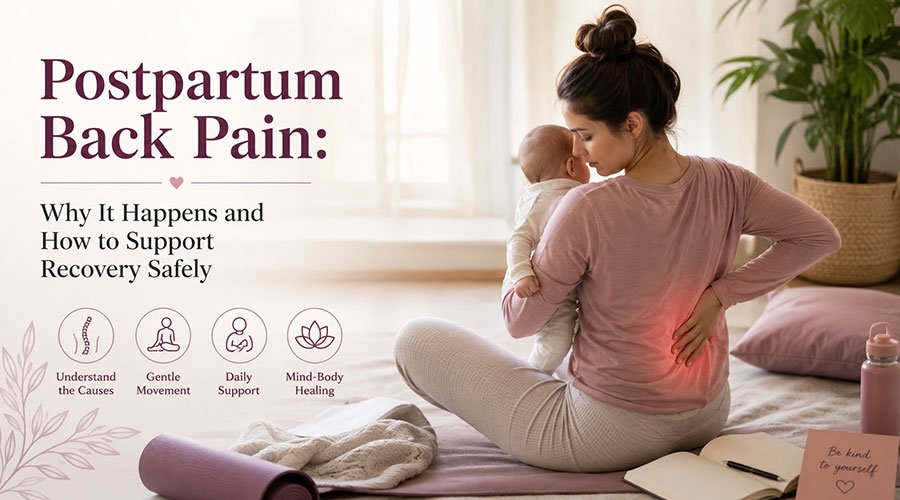
Your body has not "failed" after childbirth-it has successfully adapted to pregnancy. Throughout pregnancy, your body undergoes remarkable physical changes to support your growing baby and prepare for birth.
During pregnancy, the centre of gravity shifts, the abdominal wall stretches, the rib cage and pelvis may change position, and the body develops new movement strategies to accommodate the additional weight.
After birth, these adaptations do not disappear immediately. At the same time, new mothers begin performing hundreds of repetitive daily movements while healing, coping with fatigue, and often getting very little uninterrupted sleep.
The combination of physical recovery, hormonal changes, and the demands of caring for a newborn can place considerable stress on the back, making postpartum back pain a common experience.
Postpartum back pain is rarely caused by one single factor. Instead, it usually results from several overlapping physical changes that continue after childbirth.
As the abdomen grows during pregnancy, the body continually reorganises itself to maintain balance.
Some women develop a greater curve in the lower back, while others lean the upper body backwards, lift the ribs, or place additional pressure where the lower and middle back meet.
These movement patterns may continue after childbirth, particularly if the muscles responsible for trunk and pelvic stability have not yet regained proper coordination.
As a result, the body may continue moving and standing as though it is still supporting pregnancy-even though the baby is now being carried in the arms.
The abdominal muscles stretch significantly during pregnancy. Some women also experience Diastasis Recti, a widening between the two sides of the rectus abdominis muscles.
Although Diastasis Recti is common, the visible gap alone does not explain every case of back pain. However, reduced coordination of the deeper abdominal muscles can affect how the body manages pressure and force during lifting, bending, and carrying.
Professional guidance is recommended when abdominal separation remains noticeable after approximately eight weeks, especially if accompanied by pain or discomfort. Recovery should focus on gradual deep-core and pelvic-floor exercises rather than rushing into sit-ups, planks, or high-impact activities.
The pelvic floor does not function independently. It works together with the diaphragm, abdominal wall, breathing muscles, hips, and spine to provide stability and manage internal pressure during everyday movement.
Following childbirth, the pelvic floor may become:
This is why simply recommending more Kegel exercises is not always the correct solution. Some mothers require strengthening, while others benefit more from relaxation, mobility training, or a professional pelvic-health assessment.
Some movement professionals describe a pattern known as a high hinge point, where a person repeatedly bends or extends through the area between the lower ribs and the upper lumbar spine instead of distributing movement evenly throughout the body.
This may appear as:
A high hinge pattern cannot be diagnosed through photographs or social media videos. It is simply one possible movement pattern that may contribute to discomfort when repeated during feeding, lifting, carrying, and other daily activities.
Many new mothers spend several hours each day performing repetitive activities that gradually place additional stress on the back.
These daily movements may include:
None of these activities are necessarily harmful when performed occasionally. However, the real issue is repetition. A position that feels comfortable for a minute may become painful when repeated or maintained for several hours every day.
Recovering after childbirth is very different from recovering after a normal workout or minor injury. The body is healing while simultaneously adapting to the physical and emotional demands of caring for a newborn.
Many mothers are also managing:
Recovery may therefore be slower and less predictable than many mothers expect. The lower back and core muscles often remain weaker for some time, while the joints and ligaments may stay more flexible.
Returning too quickly to deep stretching, twisting, or high-impact exercise may increase the risk of discomfort or injury. A gradual, well-planned recovery is the safest approach.
There is no single exercise that can fix every type of postpartum back pain. The safest and most effective approach is to identify what is contributing to the discomfort and gradually rebuild healthy movement patterns.
If your back pain continues or becomes more severe, consider consulting a doctor, pelvic-health physiotherapist, or another qualified healthcare professional.
Seek professional advice if:
A professional assessment can determine whether the pain is related to the spine, pelvis, abdominal wall, pelvic floor, movement habits, or another underlying condition.
Yoga should support appropriate medical care-not replace or delay it.
During feeding, try bringing your baby closer to your body instead of repeatedly leaning forward toward the baby.
Helpful adjustments include:
Supporting your back and maintaining a comfortable posture can reduce unnecessary strain during feeding.
Everyday lifting techniques play an important role in reducing stress on the back.
Before lifting your baby or any object:
The goal is not perfect posture during every movement, but rather distributing the workload throughout the body instead of repeatedly overloading one area of the back.
Holding the breath during movement can increase unnecessary pressure and muscular tension.
A gentle exhalation while standing, lifting your baby, or getting out of bed may help the abdominal wall and pelvic floor coordinate more naturally.
A simple breathing practice may include:
Breathing exercises should always feel comfortable. Stop immediately if they increase pain, pressure, dizziness, or other symptoms.
Many mothers respond to back tightness by stretching repeatedly. However, the painful area may already be moving excessively while other parts of the body remain stiff.
A balanced postnatal recovery program may include gentle mobility exercises for:
The objective is not achieving the deepest stretch possible, but restoring comfortable, controlled movement throughout the body.
As healing progresses, strengthening exercises may include the abdominal wall, gluteal muscles, back, hips, legs, and shoulders.
Progression should always consider:
More difficult exercises are not automatically more effective. Just because an exercise is popular on social media or postpartum fitness videos does not mean it is appropriate for every mother.
A properly adapted postnatal yoga practice can support postpartum recovery by helping mothers improve:
However, postnatal yoga should never be viewed as a universal cure for postpartum back pain.
A suitable yoga class should always consider:
A qualified postnatal yoga teacher understands when to modify a practice, avoid certain techniques, and refer a student to an appropriate healthcare professional when necessary.
Simply telling a new mother to "engage the core" is not enough. A qualified prenatal and postnatal yoga teacher must understand what that instruction means for a body that may still be healing from childbirth, recovering from pelvic-floor dysfunction, or learning to coordinate breathing and abdominal pressure again.
Teaching postnatal yoga safely requires the ability to distinguish between:
For this reason, prenatal and postnatal yoga should always be taught by professionals with specialised education rather than by simply modifying a general yoga class.
Yogakulam Academy's 85-Hour Online Prenatal and Postnatal Yoga Teacher Training Course is designed to help yoga teachers understand the physical, emotional, and practical needs of women during pregnancy and postpartum recovery.
The comprehensive four-week online program covers:
The program is delivered online over 28 days through live interactive sessions with a small batch size of approximately 10-15 students, providing a more personalised learning experience.
Current batch dates, course fees, eligibility requirements, and schedules are available on the official Yogakulam Academy Online Prenatal and Postnatal Yoga Teacher Training Course page.
This course is especially suitable for:
Participants who wish to receive professional teaching certification should already have completed a 200-Hour Yoga Teacher Training Course or an equivalent recognised qualification.
Seek immediate medical care if postpartum back pain is accompanied by any of the following symptoms:
New bladder or bowel problems combined with numbness around the saddle region may indicate a rare but serious spinal emergency requiring immediate medical evaluation.
Similarly, symptoms such as chest pain, difficulty breathing, heavy bleeding, severe headaches, or sudden vision changes after childbirth should never be ignored.
Do not rely on yoga, stretching exercises, or online advice to manage these emergency symptoms. Seek urgent medical care immediately.
Back discomfort is quite common during postpartum recovery because pregnancy, childbirth, feeding positions, lifting, and reduced core support can all affect the body.
However, common does not mean it should simply be ignored. If your pain is severe, persistent, worsening, or accompanied by other symptoms, it should be assessed by a qualified healthcare professional.
There is no single recovery timeline for postpartum back pain.
Some mothers experience only temporary discomfort, while others may continue to have symptoms for several months. Recovery depends on several factors, including:
If pain begins interfering with daily life or caring for your baby, seek professional guidance rather than waiting indefinitely.
Diastasis Recti may contribute to back pain in some mothers, particularly when it is associated with poor pressure management, abdominal weakness, or difficulty coordinating the deep core muscles.
However, the width of the abdominal separation alone does not explain every symptom. Muscle function, breathing patterns, body tension, and movement coordination also play important roles.
The appropriate time to begin yoga depends on your type of delivery, healing progress, any complications, and your healthcare provider's advice.
Gentle breathing exercises and basic pelvic-floor awareness may sometimes begin early, but this does not mean that every yoga posture or exercise is appropriate immediately after childbirth.
Following a Caesarean birth, significant tearing, or other complications, individual medical guidance is especially important before beginning any exercise program.
No.
Postnatal yoga is specifically designed to support recovery after childbirth. It considers abdominal-wall healing, pelvic-floor function, hormonal changes, breastfeeding positions, fatigue, and the physical demands of caring for a newborn.
A regular yoga sequence with a few simplified poses is not automatically a safe or effective postnatal yoga practice.
No.
Postnatal yoga can complement physiotherapy and medical care, but it cannot diagnose injuries or replace an individual clinical assessment.
A responsible yoga teacher understands the limits of their professional role and refers students to appropriate healthcare professionals whenever necessary.
Yes. The 85-Hour Online Prenatal and Postnatal Yoga Teacher Training Course at Yogakulam Academy is designed to provide specialised education in pregnancy and postpartum yoga.
According to the academy's eligibility requirements, participants who wish to receive professional teaching certification should already have completed a recognised 200-Hour Yoga Teacher Training Course or an equivalent qualification.
Others may also enrol for personal development or professional enrichment, subject to the academy's admission guidelines.
Postpartum back pain is rarely the result of one incorrect movement. More often, it develops through the combined effects of pregnancy-related changes, childbirth recovery, reduced core coordination, repetitive lifting, prolonged feeding positions, and insufficient rest.
The solution is not always to stretch more, strengthen harder, or simply "push through" the discomfort.
Recovery begins with understanding the body's healing process, improving everyday movement habits, and returning gradually to appropriate physical activity.
For new mothers, this may involve professional assessment, personalised rehabilitation, and gentle movement strategies.
For yoga teachers, it means developing the knowledge to teach beyond physical postures-to observe carefully, adapt practices safely, communicate effectively, and refer students whenever appropriate.
Expand your knowledge of pregnancy anatomy, postpartum recovery, safe yoga modifications, breathwork, pelvic-floor awareness, and specialised teaching methodology through Yogakulam Academy's comprehensive 85-Hour Online Prenatal and Postnatal Yoga Teacher Training Course.
Build the confidence and professional skills needed to safely support women throughout pregnancy and postpartum recovery while advancing your teaching career.
This article is intended for general educational purposes only. It is not intended to diagnose, treat, or replace personalised medical advice from a qualified healthcare professional.
Every woman's postpartum recovery is unique. Always consult your doctor, obstetrician, midwife, or pelvic-health physiotherapist before beginning any new exercise, rehabilitation, or yoga program, especially following a Caesarean birth, complicated delivery, significant tearing, or ongoing pain.
Yogakulam Academy is dedicated to promoting wellness and mindfulness through yoga, meditation, and holistic practices. With a mission to inspire and empower individuals of all ages, we strive to create supportive and inclusive environments where personal growth and transformation flourish.
For more information about the Yoga Teacher Training and to register for upcoming programs, please visit https://www.yogakulam.com or contact Raghu Shankar at +91 7829210166
Address:
#195 3rd Main, 9th Cross, CBI Road, Ganganagar, RT Nagar, Bangalore 560032
Email: contact.yogakulam@gmail.com
Call: +91 7829210166