


Offline Yoga Teacher Training Course
Online Yoga Teacher Training Course
Contact us
Address:
#195 3rd Main, 9th Cross, CBI Road, Ganganagar, RT Nagar, Bangalore 560032
Email: contact.yogakulam@gmail.com
Call: +91 7829210166
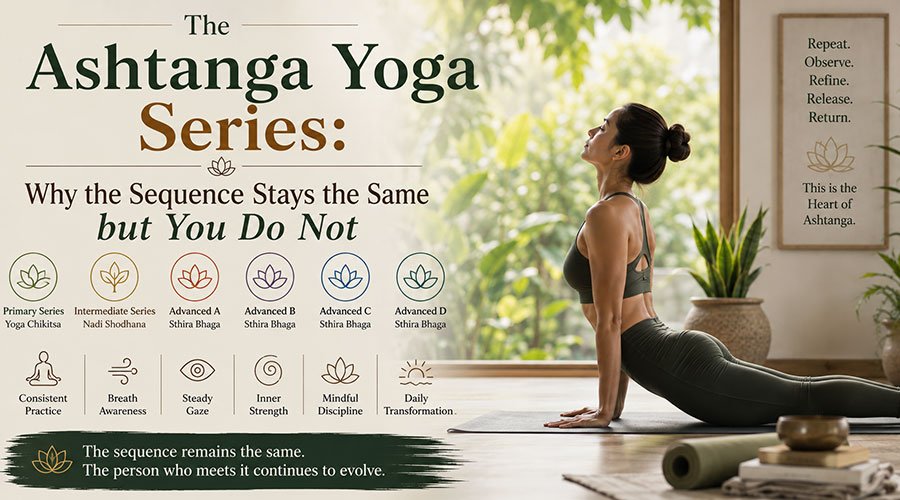
The sequence remains the same.
The practitioner does not.
This is one of the most fascinating aspects of the Ashtanga Yoga series. Unlike many modern yoga classes in which the postures change every day, the traditional Ashtanga Vinyasa Yoga method asks practitioners to return to a structured sequence repeatedly.
At first, this may appear restrictive. Why practise the same postures again and again when yoga offers hundreds of asanas?
Because repetition is not the limitation of Ashtanga Yoga.
It is the method.
When the sequence becomes familiar, the practitioner no longer needs to wonder which posture comes next. Attention can begin moving towards the quality of the breath, the direction of the gaze, the transitions between postures and the subtle changes taking place within the body and mind.
The sequence stays familiar enough to reveal what is changing inside you.
Ashtanga Vinyasa Yoga is a structured and systematic method of yoga in which postures are practised in a specific order while synchronising movement with breath. Rather than choosing poses randomly, practitioners follow a carefully designed sequence that gradually develops strength, flexibility, concentration, and self-awareness.
The modern Ashtanga method is closely associated with Sri K. Pattabhi Jois, who studied under the renowned yoga master T. Krishnamacharya in Mysore, India. Pattabhi Jois later organised and taught this series-based system, introducing it to students worldwide. Like many traditional practices, the sequences evolved over time rather than remaining completely unchanged.
A traditional Ashtanga Yoga practice generally includes:
Although Ashtanga Yoga may appear highly physical from the outside, the postures are only one aspect of the method. The practice also cultivates discipline, concentration, patience, breath awareness, and continuous self-observation.
The word Ashtanga means "Eight Limbs."
According to the Yoga Sutras of Patanjali, these eight limbs are:
Although Ashtanga Vinyasa Yoga takes its name from these eight limbs, it is important to understand that they are not exactly the same thing.
Ashtanga Vinyasa Yoga is a structured physical practice, while Patanjali's Eight Limbs describe the complete path of yoga that extends beyond physical postures into ethics, meditation, breath, awareness, and spiritual development.
A practitioner may become highly skilled in advanced postures while still being at the beginning of their journey into yoga philosophy, self-discipline, and meditation.
The physical sequence serves as a doorway into the wider practice of yoga-but it should never be mistaken for the whole of yoga itself.
What makes Ashtanga Yoga unique is not simply the postures it contains, but the way several essential elements work together as one integrated practice.
Unlike many modern yoga classes where teachers create different sequences each day, Ashtanga Yoga follows a largely predetermined order of postures.
Each posture prepares the body, breath, and mind for what follows, creating a logical progression throughout the practice.
A traditional practice usually follows this structure:
Students do not attempt the complete series immediately. Instead, new postures are introduced gradually as practitioners develop sufficient mobility, stability, breath awareness, consistency, and understanding.
In this way, the sequence becomes both a daily practice and a structured learning system.
The word Vinyasa has different meanings in different styles of yoga.
Within the Ashtanga method, it refers to the coordinated relationship between breathing and movement, including the transitional movements that connect one posture to another.
Instead of moving randomly:
This steady breathing rhythm helps organise the pace of the entire practice.
Vinyasa is not simply moving quickly. It is the harmonious integration of breath, movement, rhythm, and awareness.
A fast sequence without conscious breathing may be physically demanding, but it misses one of the defining qualities of Ashtanga Yoga.
Breath provides the rhythm and foundation of an Ashtanga practice.
Students are generally encouraged to maintain a steady, smooth, and gently audible breath throughout the practice. Yogakulam Academy's Ashtanga curriculum introduces students to the role and application of Ujjayi Breathing as an essential part of understanding the method.
The breath becomes a valuable guide throughout practice.
If breathing becomes:
It may indicate that:
Breath should never be used to force the body deeper into a posture.
Instead, it serves as a continuous guide, often revealing more about the quality of the practice than the external appearance of the posture itself.
Drishti refers to a specific point of visual focus during yoga practice.
Rather than looking around the room, comparing themselves with other students, or constantly checking their alignment in a mirror, practitioners direct their gaze toward a designated point.
The purpose extends beyond simply positioning the eyes.
Drishti helps:
When breath, posture, movement, and gaze work together, the practice gradually becomes less like an exercise routine and more like a moving meditation.
Bandhas are often described as internal energetic locks or subtle muscular engagements that help support posture, breathing, and movement.
Students of Ashtanga Yoga commonly study:
Bandhas should not be misunderstood as constantly tightening the abdomen or pelvic floor throughout the practice.
Their traditional application is considerably more subtle and is best learned gradually under the guidance of a qualified teacher.
Yogakulam Academy's 200-Hour Yoga Teacher Training Course introduces students to the practical role of Bandhas alongside Vinyasa, breath awareness, and the structure of the Ashtanga Primary Series.
Repetition is one of the most valuable learning tools in Ashtanga Yoga.
When the sequence remains relatively consistent, practitioners begin to observe subtle changes that might otherwise go unnoticed.
Over time, you may discover:
Repetition removes much of the external novelty and creates space for deeper self-observation.
Rather than repeating the same sequence out of habit, Ashtanga Yoga uses repetition as a tool for continuous learning, mindfulness, and personal transformation.
The Ashtanga Vinyasa Yoga system is traditionally organised into six progressive series, each building upon the foundation established in the previous one.
The six series are:
It is important to understand that the higher series are not simply "better" versions of yoga.
Although they contain increasingly challenging postures and transitions, true progress in yoga cannot be measured solely by the complexity of an asana.
Many practitioners spend years studying the Primary Series, continually refining their breath, awareness, alignment, and consistency.
Depth of practice is not always visible through more advanced postures. In Ashtanga Yoga, quality of awareness is considered just as important as physical achievement.
The first sequence of Ashtanga Yoga is traditionally known as Yoga Chikitsa, often translated as "Yoga Therapy" or "Yoga Treatment."
This traditional name should not be interpreted as a medical claim that the series can diagnose, treat, or cure disease.
Instead, the Primary Series provides a carefully structured foundation through a balanced combination of:
Throughout the Primary Series, practitioners gradually develop the essential principles of the Ashtanga method, including:
Although it is called the Primary Series, it should not be mistaken for an easy beginner practice.
The sequence contains physically demanding transitions and postures that require patience, consistent practice, and gradual preparation.
New students commonly begin by practising only part of the sequence, with additional postures introduced progressively under the guidance of an experienced teacher.
The objective is not to complete the entire series as quickly as possible, but to build a sustainable and lifelong relationship with the practice.
Although teaching methods may vary between schools and instructors, the Primary Series generally follows the structure below.
The practice usually begins with Surya Namaskara A and Surya Namaskara B.
These flowing movements prepare the body while introducing the essential relationship between:
The Sun Salutations gradually increase body temperature, improve concentration, and establish the rhythm that continues throughout the practice.
The standing postures create the foundation for the remainder of the practice.
They help develop:
This section prepares both the body and mind for the seated practice that follows.
The seated portion introduces a wider variety of movement patterns, including:
Students often encounter postures requiring greater patience, individual modification, and gradual progression.
Rather than forcing advancement, practitioners are encouraged to develop stability and understanding before moving to more demanding postures.
Backbending is generally introduced after completing the main series-specific sequence.
The quality of a backbend should never be judged solely by how deeply the spine bends.
A safe and effective backbend also depends upon:
Each practitioner approaches backbending differently according to their own anatomy and experience.
The finishing sequence traditionally includes inversions followed by seated closing postures.
These practices should always be taught according to the student's:
Proper supervision and thoughtful progression remain essential throughout this stage of the practice.
Savasana (Final Relaxation) is an integral part of the Ashtanga practice rather than something separate from it.
After completing the physical sequence, practitioners allow the body and mind to absorb the effects of the practice through stillness and quiet observation.
Skipping the final rest simply to complete more postures works against the purpose of a balanced and complete yoga practice.
True Ashtanga Yoga is not measured by how many postures are completed, but by the quality of awareness carried throughout the entire sequence-from the opening breath to the final moments of rest.
The Intermediate Series of Ashtanga Yoga is traditionally known as Nadi Shodhana, a Sanskrit term commonly translated as "purification" or "cleansing of the nadis."
Within traditional yoga philosophy, Nadis are part of the subtle-body framework and should not automatically be interpreted as physical nerves, blood vessels, or other anatomical structures.
Compared with the Primary Series, the Intermediate Series places greater emphasis on:
Progressing to the Intermediate Series should never be viewed simply as completing every posture in the Primary Series.
Instead, progression is best guided by an experienced teacher who evaluates the individual practitioner rather than judging only the external appearance of the postures.
A student's readiness may include:
The next series should never become a reward for ambition.
Instead, it represents greater responsibility, deeper awareness, and continued refinement within the Ashtanga practice.
The Advanced Series are traditionally associated with the name Sthira Bhaga, often understood as "Stable Strength" or "Divine Stability."
These advanced sequences include highly demanding postures requiring exceptional levels of:
Only a relatively small number of practitioners progress into these advanced sequences.
However, they are not required in order to gain a meaningful understanding of Ashtanga Yoga.
A practitioner capable of performing advanced postures is not automatically more disciplined, self-aware, or better qualified to teach than someone who continues refining the Primary Series with patience and consistency.
The external shape of a posture is visible, but the depth and quality of practice are often invisible.
Ashtanga Yoga is traditionally taught through two complementary learning formats, each serving a different educational purpose.
Mysore-style practice takes its name from Mysuru, India, where the modern Ashtanga system was developed.
In this format, each student practises the sequence at their own pace while the teacher moves around the room offering individual instruction and adjustments.
Unlike a typical group class:
This teaching style allows the instructor to closely observe:
Mysore-style classes are not advanced classes reserved only for experienced practitioners.
Traditionally, they are one of the primary ways students gradually learn the Ashtanga sequence.
In a Led Class, the teacher guides the entire group through the sequence using a shared rhythm, count, and pace.
Led classes help students understand:
Although Mysore-style practice and Led Classes are different, they complement one another.
Together they help students develop both personal responsibility and a deeper understanding of the formal structure of the Ashtanga method.
From the outside, repeating the same yoga sequence may appear repetitive or monotonous.
Within the Ashtanga tradition, however, repetition creates valuable opportunities for continuous learning and self-observation.
As students gradually memorise the sequence, they rely less on external instruction and take greater responsibility for their own practice.
Practising the same sequence regularly allows practitioners to notice gradual improvements in:
Because the sequence remains familiar, changes become easier to recognise over time.
When creating their own practice, many people naturally choose favourite postures while avoiding more challenging ones.
A fixed sequence removes that choice, encouraging practitioners to face both their strengths and their weaknesses with honesty.
The same sequence can feel completely different from one day to the next.
This encourages practitioners to observe how factors such as:
influence their practice, rather than immediately blaming the sequence itself.
Ashtanga Yoga invites practitioners to ask a different question from constantly changing yoga classes.
Rather than asking:
"What new posture can I practise today?"
the practice encourages a deeper question:
"How honestly can I meet this familiar practice today?"
This shift from seeking novelty to cultivating consistency is one of the defining qualities of the Ashtanga tradition, helping practitioners develop patience, discipline, humility, and lifelong self-awareness.
Flexibility may make certain postures appear easier, but it does not automatically create stability, breath awareness, concentration, or mindful practice.
Students with limited mobility can absolutely begin Ashtanga Yoga by practising suitable modifications, shortened sequences, and gradual progressions under qualified guidance.
Beginners are not expected to perform every posture in the Primary Series.
A shorter practice performed with careful attention, steady breathing, and proper technique is far more valuable than forcing the complete sequence before the body and mind are ready.
While the traditional sequence provides a consistent framework, every practitioner has different:
A qualified teacher understands when to modify, pause, simplify, or replace movements so the practice remains both safe and effective.
Healthy effort and physical discomfort are not the same as pain.
Sharp, persistent, increasing, or unusual pain should never be treated as evidence that the practice is working.
Listening to the body's signals is an important part of responsible yoga practice.
An advanced posture demonstrates a particular physical skill.
It does not automatically reflect a person's ethics, awareness, humility, discipline, compassion, or ability to teach others safely.
True progress in yoga extends far beyond physical achievement.
Although Ashtanga Yoga is physically demanding, the practice also develops:
The physical sequence serves as a vehicle for cultivating mental clarity and deeper awareness.
Yes.
Beginners can successfully study Ashtanga Yoga when the practice is introduced gradually and under appropriate guidance.
A responsible introduction may include:
Beginners should never feel pressured to match experienced practitioners.
Completing the entire Primary Series is not an entry requirement.
Consistency, curiosity, patience, and a willingness to learn provide a much stronger foundation for long-term progress.
A chart, book, or online video may show the order of the postures.
However, they cannot fully teach how to:
To understand Ashtanga Yoga as both a practitioner and future teacher, students should study:
This is where a structured Yoga Teacher Training program becomes especially valuable.
Ashtanga Yoga forms an important part of Yogakulam Academy's approximately four-week 200-Hour Yoga Teacher Training Course in Kerala.
The current 24-day residential program introduces trainees to the structure and sequential methodology of the Ashtanga Vinyasa Primary Series.
As part of the Ashtanga syllabus, students study:
Ashtanga Yoga is studied alongside other essential subjects, including:
The course currently includes a daily Ashtanga practice session together with Hatha Yoga, Pranayama, meditation, philosophy, anatomy, alignment, and practical teaching experience.
The program provides a strong foundation in yoga techniques, anatomy, philosophy, ethics, and teaching skills for aspiring yoga teachers.
Even students who do not intend to teach traditional Ashtanga classes can gain valuable teaching skills by studying this method.
Students learn how postures can be organised into a logical progression rather than selected randomly.
Practitioners experience how inhalation and exhalation influence movement, timing, concentration, and transitions.
A consistent sequence encourages commitment and regular practice even when the excitement of novelty is absent.
Repeated practice makes movement habits easier to recognise, helping future teachers observe students more effectively.
Students discover that advanced postures are developed gradually through preparation, patience, and consistency rather than imitation.
Performing an Ashtanga sequence and teaching it safely are very different skills.
Teacher training develops communication, demonstration, modification, classroom management, observation, and student safety alongside personal practice.
Individual guidance is especially valuable when learning the sequence, breathing techniques, transitions, and appropriate modifications.
Do not judge your progress by how quickly you receive the next posture.
Steady improvement is far more valuable than rushing through the sequence.
If your breathing becomes repeatedly strained or uncontrolled, reduce the intensity or pause the practice until your breath returns to a comfortable rhythm.
Two practitioners may perform the same posture differently because of differences in body proportions, mobility, strength, previous injuries, and movement history.
Yoga should adapt to the individual-not the other way around.
Pain should never become accepted as a normal part of the Ashtanga tradition.
Listen carefully to your body's signals and seek guidance whenever something feels unsafe or unusual.
More practice does not always produce better results.
Sleep, nutrition, stress management, and adequate recovery all influence how the body responds to regular yoga practice.
Asana is only one aspect of yoga.
Its deeper purpose is to cultivate awareness, presence, discipline, and self-understanding-not to become another source of comparison, competition, or personal identity.
When approached with patience, humility, and consistent practice, Ashtanga Yoga becomes much more than a sequence of postures-it becomes a lifelong method of self-study and mindful transformation.
The Primary Series is the first sequence within the Ashtanga Vinyasa system. It includes Sun Salutations, standing postures, seated postures, backbending, finishing postures, and final relaxation.
The Primary Series is traditionally known as Yoga Chikitsa, often translated as "Yoga Therapy."
Yes.
Beginners can begin Ashtanga Yoga with a shorter, carefully modified sequence under qualified guidance. There is no expectation to complete the entire Primary Series immediately.
Students gradually learn additional postures as they develop sufficient strength, mobility, breathing awareness, and consistency.
The modern Ashtanga Vinyasa system is commonly organised into six series:
The sequences have also evolved over time during the development and transmission of the Ashtanga method.
No.
Although both styles coordinate movement with breath, Ashtanga Yoga follows a largely predetermined sequence, whereas most modern Vinyasa Yoga classes vary their sequencing from one class to another.
Mysore-style is a traditional self-paced learning method where students practise individually within a shared classroom while receiving personalised guidance, adjustments, and progression from the teacher.
No.
Flexibility is only one aspect of physical practice. Strength, coordination, breathing, concentration, body awareness, and appropriate modifications are equally important for long-term progress.
Yes.
The current Yogakulam Academy curriculum includes:
The current residential course is conducted over 24 days, which is approximately four weeks of immersive yoga teacher training.
A 200-hour Yoga Teacher Training provides a strong foundation in yoga teaching and introduces the Ashtanga Primary Series.
However, teaching traditional Ashtanga Yoga responsibly generally requires continued personal practice, mentorship, further study, and practical teaching experience beyond the initial certification.
The true power of Ashtanga Yoga does not come from mastering the most difficult posture or completing the longest sequence.
Its power comes from showing up consistently.
You return to the breath.
You return to the gaze.
You return to the sequence.
Most importantly, you return to yourself with enough honesty and awareness to notice what has changed.
The postures provide the structure, but the deeper practice develops through your relationship with:
The sequence may remain the same, but the practitioner continues to grow with every practice.
Develop a deeper understanding of Ashtanga Vinyasa Yoga alongside Classical Hatha Yoga, Pranayama, Meditation, Anatomy, Yoga Philosophy, Alignment, and Teaching Methodology through Yogakulam Academy's immersive four-week residential Yoga Teacher Training in Kerala.
Build the knowledge, confidence, and practical teaching skills needed to guide others with safety, clarity, and authenticity while deepening your own personal yoga journey.
Yogakulam Academy is dedicated to promoting wellness and mindfulness through yoga, meditation, and holistic practices. With a mission to inspire and empower individuals of all ages, we strive to create supportive and inclusive environments where personal growth and transformation flourish.
For more information about the Yoga Teacher Training and to register for upcoming programs, please visit https://www.yogakulam.com or contact Raghu Shankar at +91 7829210166
Address:
#195 3rd Main, 9th Cross, CBI Road, Ganganagar, RT Nagar, Bangalore 560032
Email: contact.yogakulam@gmail.com
Call: +91 7829210166